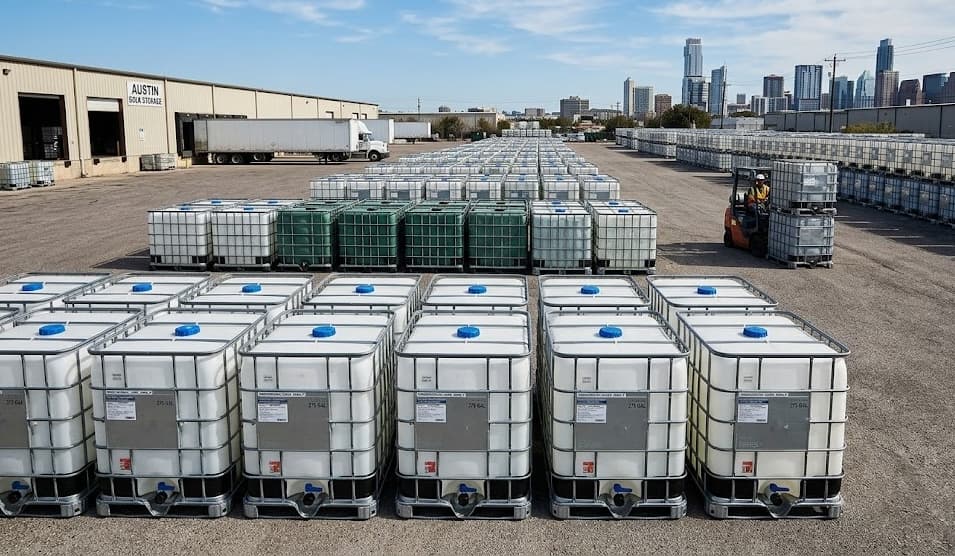
New IBC Tanks
When your application demands a container with zero history — no prior contents, no previous exposure, no compromise — a brand-new IBC tank is the right choice.
When to Buy New vs. Reconditioned
For many applications, a reconditioned IBC provides excellent performance at a lower cost. However, certain situations require a new container. Pharmaceutical manufacturing and sensitive chemical processing often mandate first-use-only vessels to eliminate any risk of trace contamination. Regulatory compliance for UN/DOT certified hazardous material transport may require new containers with intact original certification markings. Companies building long-term branded dispensing systems also benefit from starting with a pristine container that will carry their label for years.
If you are unsure whether new or reconditioned is the better fit for your use case, our team can help you evaluate the technical requirements, cost implications, and compliance factors so you make the most informed decision.
Material Specifications
HDPE (Polyethylene)
- -High-density polyethylene inner bottle, blow-molded for uniform wall thickness
- -UV-stabilized virgin resin — resistant to sunlight degradation for outdoor storage
- -Compatible with a wide range of chemicals, detergents, food products, and water
- -Galvanized steel cage with welded tubular frame, powder-coated options available
- -Available in 275-gallon and 330-gallon capacities with wood, plastic, or steel pallets
- -Operating temperature range: -40 degrees F to 150 degrees F
Stainless Steel (304 / 316L)
- -Single-wall or jacketed 304 or 316L stainless steel construction
- -Electropolished interior for ultra-smooth surface finish (Ra ≤ 0.5 μm available)
- -Ideal for aggressive chemicals, high-purity pharmaceuticals, and high-temperature processes
- -CIP (clean-in-place) compatible — steam or chemical sterilization without disassembly
- -Optional heating/cooling jacket, insulation blanket, and agitator mounting
- -Operating temperature range: -40 degrees F to 400 degrees F
UN/DOT Ratings & Compliance
All new HDPE IBCs we supply are manufactured to UN 31HA1 (composite IBC with rigid plastic inner receptacle and outer steel cage) specifications. They carry the required UN packaging mark stamped on the bottle, certifying them for the transport of liquids in hazard groups II and III as defined by DOT 49 CFR regulations.
Stainless steel IBCs are rated UN 31A (metal IBC) and can be specified for hazard group I, II, or III depending on wall thickness and closure type. We can supply containers with specific Packing Group ratings, vapor-tight closures, and pressure relief devices to match your shipping compliance requirements. All new IBCs ship with original manufacturer certification and test documentation.
Available Brands & Custom Configurations
We partner with established IBC manufacturers including Schutz, Mauser, Greif, and TPS to source new tanks in standard and custom configurations. Custom options include:
Specifications by Brand
We source new IBCs from four leading manufacturers. While all meet industry standards, each brand has distinct strengths. Here is a detailed comparison.
Lead Times & Ordering Process
Standard Lead Times
New IBC tanks are manufactured to order by our partner brands. Standard HDPE configurations in 275 or 330 gallon sizes typically ship within 2-4 weeks from order confirmation. Stainless steel IBCs require 4-8 weeks depending on alloy type and custom specifications.
How to Order
Request a Quote
Contact us with your size, material, quantity, and any custom requirements. We respond within 24 hours.
Review & Approve
We provide a detailed quote with specs, lead time, and total pricing including freight. You review and approve.
Production & QC
Your order goes into production at the manufacturer. We coordinate quality checkpoints throughout the build.
Delivery or Pickup
Finished IBCs ship direct from the manufacturer or stage at our Hebron, KY facility for local pickup. We handle all logistics.
Did You Know?
A new HDPE IBC bottle is blow-molded from a single piece of high-density polyethylene resin in a process that takes less than 3 minutes. The molten plastic parison is inflated inside a precision mold at pressures up to 100 PSI, creating a seamless, jointless vessel with uniform wall thickness. This single-piece construction is what makes HDPE IBCs inherently leak-proof — there are no seams, welds, or joints that could fail.
Customization Options in Detail
Valve Configurations
Choose from multiple valve types to match your dispensing system:
- - Butterfly valve (PP): Standard quarter-turn, full-bore flow, easy cleaning
- - Ball valve (SS): Precision shut-off, drip-free, chemical-resistant
- - Cam lock fitting: Quick-connect for hoses, no threading required
- - Banjo fitting: Common in agricultural and chemical dosing applications
- - Tri-clamp (SS IBCs): Sanitary connection for pharma and food processing
Gasket Materials
The right gasket prevents leaks and ensures chemical compatibility:
- - EPDM: Water, food-grade, mild chemicals (-40°F to 250°F)
- - Viton (FKM): Fuels, solvents, aggressive chemicals (-15°F to 400°F)
- - PTFE (Teflon): Universal compatibility, chemically inert (-100°F to 500°F)
- - Silicone: High-purity, pharma-grade, FDA compliant (-75°F to 400°F)
- - Buna-N (Nitrile): Petroleum-based fluids, oils, hydraulic fluids (-30°F to 250°F)
Anti-Static & Conductive Options
Essential for flammable liquid applications:
- - Anti-static HDPE: Carbon-impregnated resin prevents static charge buildup during filling and dispensing
- - Conductive grounding lugs: Welded to cage for direct earthing connection
- - ATEX-compliant configurations: Meets European explosive atmosphere directives
- - Required for: Alcohols, solvents, flammable coatings, and fuel-adjacent products
Pallet Type Selection
The pallet affects weight, durability, and export compliance:
- - Wood pallet: Lightest, lowest cost, ISPM-15 heat-treated for export
- - Steel pallet: Most durable, best for heavy liquids and aggressive stacking
- - HDPE plastic pallet: Rot-proof, chemical-resistant, no ISPM-15 required
- - Composite pallet: Balanced cost, weight, and durability for most applications
The Material Science Behind IBC Construction
HDPE: Why It Dominates the Market
High-density polyethylene (HDPE) is a semi-crystalline thermoplastic with a density range of 0.941-0.965 g/cm³. Its molecular structure — long, mostly linear chains of ethylene monomers with minimal branching — gives it exceptional tensile strength, chemical resistance, and impact toughness. These properties make it the ideal material for IBC bottles that must withstand filling pressures, transport vibration, stacking loads, and chemical exposure over years of service.
The virgin HDPE resin used in new IBCs is UV-stabilized with additives that absorb ultraviolet radiation and prevent the chain-scission reactions that cause brittleness and cracking in sun-exposed plastics. This UV package is what allows new HDPE IBCs to be stored outdoors for extended periods without rapid degradation — though indoor storage is always preferred for maximum lifespan.
HDPE is also inherently FDA-compliant when manufactured from food-contact-approved resin grades per 21 CFR 177.1520. It does not leach harmful chemicals into stored products and is resistant to bacterial growth on its surface, making it the material of choice for food, beverage, and pharmaceutical containers.
Stainless Steel: When HDPE Is Not Enough
For applications that exceed the chemical or thermal limits of HDPE, stainless steel IBCs offer a step up in performance. The two most common alloys used are 304 and 316L.
304 Stainless Steel contains approximately 18% chromium and 8% nickel. The chromium forms a passive oxide layer on the surface that resists corrosion from most food products, mild chemicals, and atmospheric exposure. 304 is the standard choice for food processing, brewing, dairy, and general industrial applications.
316L Stainless Steel adds 2-3% molybdenum and uses a low-carbon formulation. The molybdenum dramatically improves resistance to chloride pitting and crevice corrosion, while the low carbon content prevents sensitization during welding. 316L is specified for pharmaceutical manufacturing, marine environments, and aggressive chemical applications involving chlorides, bromides, or strong acids.
Electropolishing — an electrochemical process that removes a thin surface layer — creates an ultra-smooth interior finish (Ra ≤ 0.5 μm) that resists product adhesion, simplifies cleaning, and eliminates microscopic crevices where bacteria could harbor. This is why electropolished 316L is the gold standard for pharmaceutical and high-purity applications.
Did You Know?
The galvanized steel cage surrounding an HDPE IBC bottle is not just for protection — it is a critical structural component. The cage absorbs stacking loads so the plastic bottle does not have to bear weight. It also provides the forklift handling points and tie-down anchors for secure transport. Without the cage, an HDPE bottle full of liquid would deform under its own weight and could not be safely stacked or moved with a forklift.
Explore Related Products & Resources
Reconditioned IBCs
Near-new quality at 40-60% of new cost
Used IBC Totes
Budget-friendly graded containers
Food-Grade IBCs
FDA-compliant for food and pharma
IBC Accessories
Valves, gaskets, adapters, heaters
Custom Solutions
Modified containers and systems
275-Gallon IBCs
Standard size — universal compatibility
330-Gallon IBCs
Maximum payload per pallet
IBC Knowledge Base
Guides, tips, and industry insights
Frequently Asked Questions
What is the typical lead time for new IBC tanks?
Can I get custom branding on new IBCs?
Should I choose HDPE or stainless steel?
What is the minimum order quantity for new IBCs?
Do new IBCs come with UN/DOT certification?
How does new IBC pricing compare to reconditioned?
Order New IBC Tanks
Contact IBC Cincinnati at 1405 Worldwide Blvd, Hebron, KY 41048 for pricing, lead times, and custom configuration options.